Morocco and its beautiful contradictions.
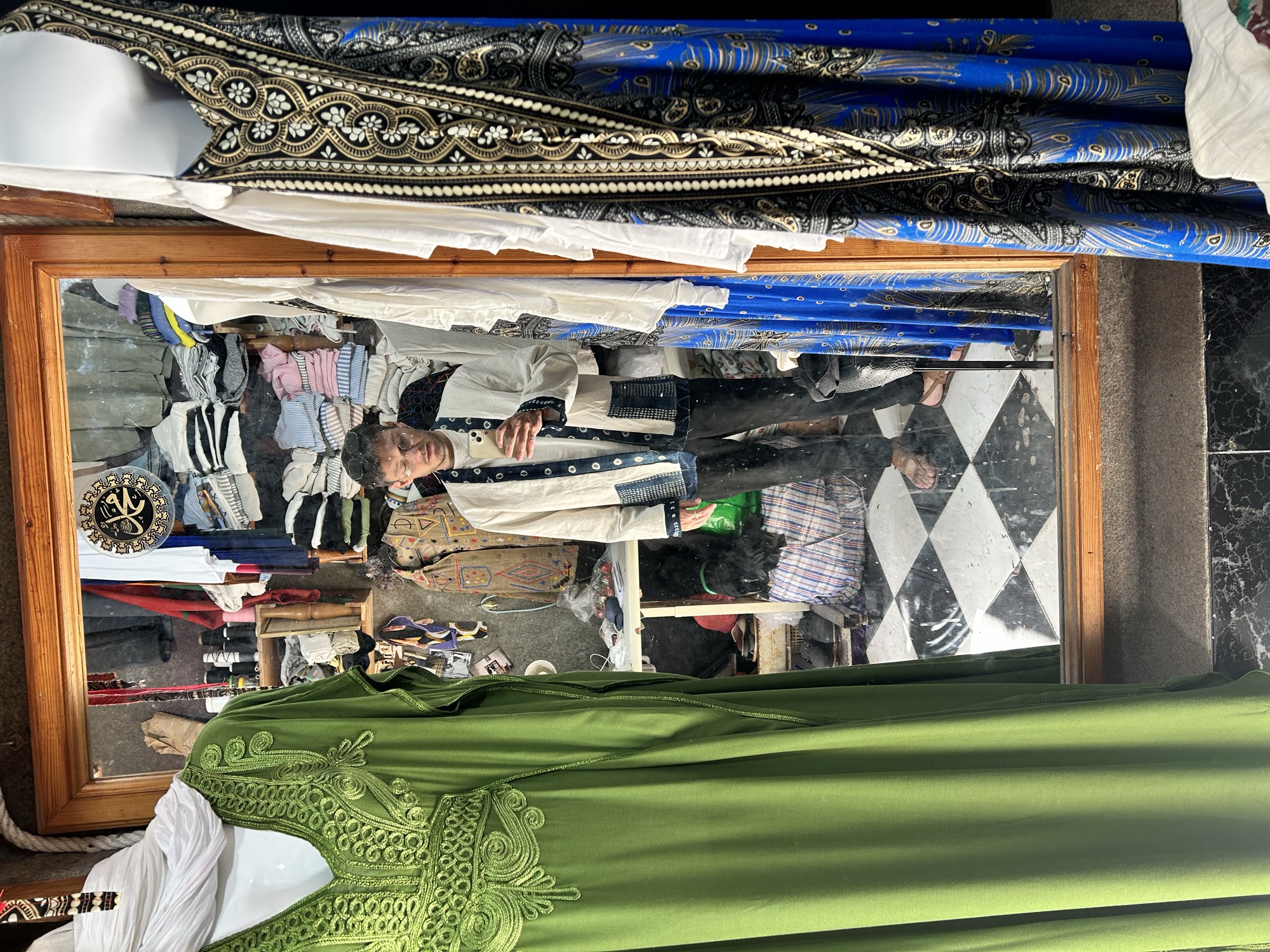
What I discovered in Morocco can’t be reduced to a landscape or a culture. It is a whole of contrasts, encounters and sensations that gradually changed the way I look. From that experience, OXYGEN was born.
Over my travels, I learned to look beyond my first impressions. To observe more, to listen, to try to understand what plays out behind people’s behaviour, but also behind the images we build of others.
Morocco nourished that urge in particular.
I grew up in Roubaix, in the north of France, a town marked by a strong presence of people of North African descent. I grew up in the middle of that cultural mix — its habits, its expressions, its codes and its traditions. A culture that was part of my daily life, yet whose roots I knew very little about.
My travels in Morocco let me look differently at part of my own surroundings. In a way, I had gone abroad to discover a culture I had grown up with here, without ever really knowing its history. Putting images, stories and realities onto things I had lived alongside throughout my childhood.
A beautiful contradiction.
During my last stay in Morocco, a contradiction appeared to me.
On one side, this country offers a human richness that left a deep mark on me. A capacity to create, to undertake, to improvise, to welcome and to find solutions where many would already have given up. Its people have an almost disconcerting energy to get around obstacles, to connect and to build closeness with others within minutes, with a spontaneity and a sincerity I have rarely met elsewhere.
In Morocco: things move.
But behind that, I also discovered difficulties. They are institutional, administrative or social. They come to contradict individual ingenuity, which then has to constantly make up for the limits of collective structures.
And having to find solutions where structures don’t provide them, people develop other ways of functioning. You learn to work with the rules, to negotiate, to get around them, sometimes to bend them, simply to keep moving forward.
And perhaps that is where another contradiction is born: certain behaviours, partly shaped by an environment where you must constantly fend for yourself, then become clichés in the eyes of the rest of the world.
The gap that strikes me.
Human potential is immense, but the space to express it isn’t always equal to it.
What some perceive as pushiness, cunning or a lack of rigour can also be the result of necessity. A way of adapting to a daily life whose rules of the game aren’t always simple.
We sometimes end up judging a way of doing things without seeking to understand what made it necessary.
It is this gap that strikes me. This feeling that individuals move forward, adapt and invent, sometimes despite the structures they live within.
And this question that keeps coming back: what might we see emerge if everyone’s potential had more space to express itself?
Beyond Morocco.
This reflection obviously goes beyond Morocco.
By observing other cultures, other ways of living and other relationships to everyday life, I began to question more broadly what we consider normal. Our habits, our priorities, our way of working, of connecting or of picturing success.
What seems obvious to us here isn’t necessarily so elsewhere. And what we sometimes judge in others perhaps deserves to be looked at with more distance.
Above all, these travels reminded me that our way of inhabiting the world is not universal. It is also the product of our environment, our history and our experiences.
To breathe.
It is from this whole of contrasts and feelings that OXYGEN gradually came to life.
More than a representation of Morocco, the project is a visual and sensory translation of what this country made me feel. An exploration of that tension between the energy of the living and the constraints that can hinder it. Between movement and stillness, momentum and its limit.
OXYGEN doesn’t seek to bring an answer. It gives a form to these contradictions.
Because to breathe is perhaps not simply to have space around oneself. It is also to let what moves us flow freely, without having to hold it back all the time.